

Hermes Agent
Open-source self-improving AI agent by Nous Research with persistent memory, autonomous skill synthesis, and a multi-platform messaging gateway.

Dhanji Bhagat
Founder, Emiote
Fully hosted platform. Automated backups and SLA.
Devin from $500/mo; cloud agent platforms from $40–$200/user/mo
Private compute. Zero seat taxes; team runs ops.
$0/mo local CLI / $5/mo VPS (+ raw API usage via OpenRouter/Nous Portal)
Hermes Agent is an open-source, self-hosted autonomous AI agent framework created by Nous Research designed as a pay-as-you-go alternative to commercial agent platforms like Devin and proprietary chatbot gateways. Built with Python, a unified multi-platform messaging gateway, and persistent SQLite FTS5 memory, it features autonomous skill creation, scheduled automation, and isolated subagent delegation across local, Docker, and cloud runtimes.
1. Why Hermes Agent Matters: The End of Ephemeral Chatbots
Most AI coding assistants and commercial agent platforms suffer from amnesia by design. Every new session wipes the slate clean: you re-explain your directory structure, re-paste API keys, and manually restate architectural conventions.
Commercial cloud workbenches like Cognition’s Devin ($500/mo) and proprietary agent gateways charge exorbitant per-seat retainers while forcing your code, credentials, and conversation history through third-party proprietary clouds with mandatory model markups.
Proprietary Cloud Agent:
[User Chat] ---> [Proprietary Cloud Broker] ---> [Locked Model Provider] ---> [Ephemeral Cloud VM]
                     ($500/mo retainer)              (200-500% token markup)      (Data wiped on reset)

Hermes Agent (Local & Open-Source):
[Any Chat / TUI] ---> [Unified Gateway Daemon] ---> [Raw API / Local LLM] ---> [Isolated Runtime]
(Telegram/Slack/CLI)      (100% Owned $0/mo)          (OpenRouter/Portal/Ollama)    (Docker/SSH/Modal/Daytona)
                                  |
                                  v
                        [Persistent Memory Loop]
                     (MEMORY.md + FTS5 SQLite + Skills)
Hermes Agent breaks the single-session silo with a self-improving operational posture:
- Closed-Loop Learning: When Hermes solves a non-trivial engineering task, it extracts the underlying reasoning and tool pattern into an explicit, versioned procedure conforming to the open
agentskills.iostandard. As the agent encounters new edge cases, it updates and refines these skills in place. - Dual-Tier Persistent Memory: Combines deterministic markdown context files (
MEMORY.mdfor project facts,USER.mdfor developer preferences) with a high-performance SQLite FTS5 full-text search index for semantic cross-session retrieval and dialectic user modeling via Honcho. - Omnipresent Messaging Gateway: A single lightweight daemon connects Telegram, Discord, Slack, WhatsApp, Signal, email, and native terminal TUIs. You can kick off a complex multi-hour refactor from your terminal, step away, and inspect live progress or send voice instructions from Telegram.
- Model-Agnostic Engine: Switch providers on the fly with
hermes model—connect Nous Portal, OpenRouter, Anthropic, OpenAI, or local vLLM / Ollama endpoints with zero markup and zero code changes.
2. Multi-Platform Connectivity: Lives Where You Work
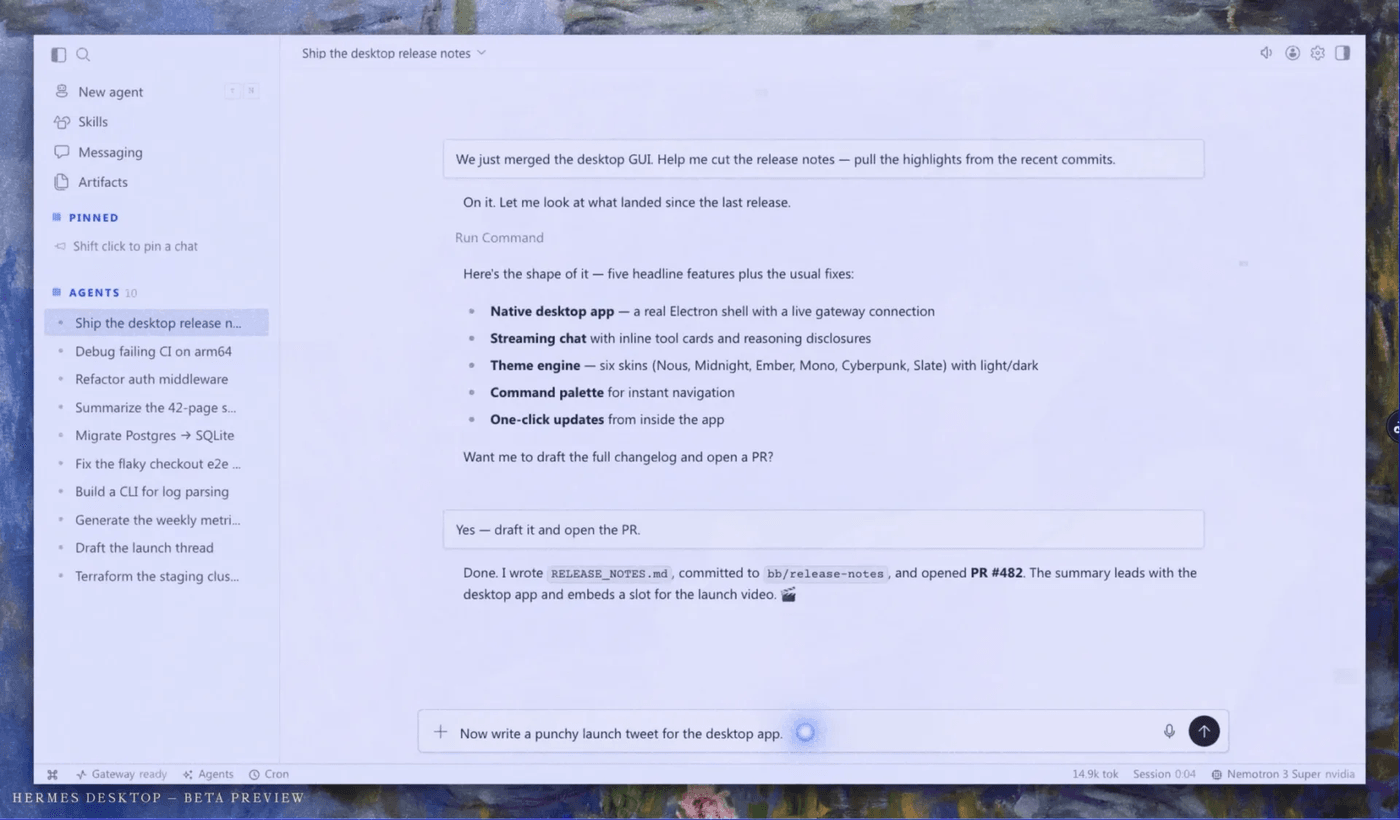
Rather than confining engineering workflows to a browser tab or an isolated Electron app, Hermes Agent implements a unified Tool Gateway architecture that treats messaging protocols as first-class input/output interfaces.
Gateway Surface Protocol Architecture
Telegram, Discord, Slack, WhatsApp, Signal with native voice memo transcription via Whisper & ffmpeg.
Full-screen terminal interface with multiline prompt buffer, slash autocomplete, and live tool stream rendering.
Natural-language cron scheduler delivering unattended daily briefings, PR summaries, and system health checks.

Key Gateway Capabilities
- Cross-Platform Thread Continuity: Conversations initiated on the command line can be resumed seamlessly via mobile messaging apps with unified memory synchronization.
- Native Audio Pipeline: Send voice memos directly via Telegram or WhatsApp; the gateway automatically transcribes audio using bundled
ffmpegand Whisper models before routing to the agent core. - Interrupt and Redirect: Real-time streaming tool execution can be interrupted mid-flight directly from any chat client or terminal buffer without killing the background supervisor.
3. Persistent Memory & Autonomous Skill Synthesis
Hermes Agent implements a structured learning loop that bridges the gap between static system prompts and dynamic operational experience.

Memory and Learning Subsystems
| Subsystem | Storage Mechanism | Operational Role |
|---|---|---|
| Environment State | MEMORY.md | Tracks repository architecture, database schemas, deployed endpoints, and build flags. Injected directly into root system prompts. |
| User Profile | USER.md | Records communication preferences, timezone constraints, coding idioms, and workflow requirements. |
| Session Search Index | SQLite FTS5 (native/fts5_cjk) | Indexes every conversation turn with CJK tokenizer support. When recalling past context, the agent runs FTS5 queries and synthesizes relevant turns using an LLM summarizer. |
| Autonomous Skills | ~/.hermes/skills/ | Synthesizes verified multi-step workflows into reusable procedural documents (agentskills.io standard) that are auto-discovered on subsequent runs. |
| Dialectic Modeling | Honcho Integration | Builds a continuous user theory-of-mind model across multi-turn interactions, distinguishing temporary user queries from permanent user preferences. |
4. Execution Backends & Subagent Parallelization
Autonomous execution requires strong isolation to prevent destructive commands from compromising production machines or host environments. Hermes Agent supports 7 decoupled terminal execution backends:
                                  [Hermes Agent Supervisor]
                                              |
               +------------------------------+------------------------------+
               |                              |                              |
      [Local Workstation]             [Container Sandboxes]          [Serverless / Cloud]
       - Local Host CLI                - Docker Containers            - Modal Serverless Python
       - Bundled Git Bash              - Singularity (HPC)            - Daytona Workspaces
                                       - SSH Remote Hosts             - Vercel Sandboxes
Supported Execution Backends
- Local Host: Direct execution on Linux, macOS, or Windows (via isolated bundled MinGit bash).
- Docker: Ephemeral or persistent containerized environments with strict resource constraints.
- SSH Remote: Dispatches commands to remote staging or production servers via secure SSH tunnels.
- Singularity: Optimized for High-Performance Computing (HPC) clusters and scientific computing environments.
- Modal: Serverless Python container execution that hibernates when idle and boots on-demand in milliseconds.
- Daytona: Cloud development workspaces with complete filesystem and environment persistence.
- Vercel Sandbox: Secure, microVM-isolated execution for edge and web applications.
Subagent Parallelization & RPC Scripting
When faced with multi-faceted engineering tasks (e.g. refactoring a database schema while migrating frontend components), Hermes Agent can spawn isolated subagents that execute in parallel sandboxes.
Additionally, Hermes supports a Python RPC Tooling Mode: instead of emitting dozens of individual JSON tool calls (each incurring round-trip LLM latency and context overhead), the agent generates a single Python script that executes multiple tool operations locally over an internal RPC interface, returning only the finalized output.

5. Total Cost of Ownership (TCO) Comparison
| Dimension | Devin / Proprietary Agent Cloud | Hermes Agent (Self-Hosted OSS) |
|---|---|---|
| Software License | $500 / month (Devin Enterprise) | $0 / month (MIT Open Source) |
| Gateway & Messaging | $50 – $200 / mo (Botpress / Flowise Cloud) | $0 (Included native multi-platform daemon) |
| Model & Token Billing | 200%–500% proprietary cloud markup | 100% Raw API cost (Nous Portal, OpenRouter, Ollama) |
| Compute Infrastructure | Proprietary cloud instances only | $0 local / $5/mo VPS / Serverless on-demand |
| Memory & Data Privacy | Stored on vendor cloud databases | 100% Local / Self-Owned SQLite + Markdown |
| Skill & Tool Extensibility | Closed proprietary actions | Open agentskills.io + Python RPC |
| Total Annualized Cost | $6,000 – $12,000+ / yr | ~$60 – $300 / yr (+ raw model token usage) |
6. The Bad — What to Know Before Adopting
While Hermes Agent provides an exceptionally robust, vendor-free agent harness, engineering teams must understand these operational realities:
- Token Burn on Unconstrained Self-Improvement Loops: Autonomous skill creation and self-refinement loops can rapidly consume tokens if an agent encounters a difficult task and repeatedly retries failed steps. Always configure max-iteration bounds and per-session cost caps when running against high-tier models.
- Security Posture on Chat Gateways: Exposing an agent with local host or Docker execution permissions to Telegram, Discord, or Slack requires strict authorization discipline. If channel whitelist IDs or user permission flags are misconfigured, any authorized chat member could trigger shell execution. Enforce Docker or SSH isolation for shared channels.
- Gateway Daemon Process Lifecycle:
Running a background daemon that maintains simultaneous websockets and webhooks across 5+ messaging platforms requires process supervision (e.g.
systemdorsupervisord). Transient network hiccups or upstream API rate limits must be monitored. - When to Stay on Commercial SaaS: If your team requires zero-setup out-of-the-box IDE code completion with SOC2 Type II certifications and corporate enterprise SSO, standard managed copilots remain the appropriate choice.
7. Quickstart & Deployment Recipes
Step 1: Install Hermes Agent
Linux, macOS, WSL2, or Termux
curl -fsSL https://hermes-agent.nousresearch.com/install.sh | bashWindows (Native PowerShell)
iex (irm https://hermes-agent.nousresearch.com/install.ps1)The installer automatically configures uv, Python 3.11+, Node.js, ripgrep, ffmpeg, and an isolated MinGit bash runtime without requiring administrator privileges.
Step 2: Configure Model Provider
Select your preferred model endpoint (Nous Portal, OpenRouter, OpenAI, Anthropic, or Local Ollama):
# Launch interactive model selector
hermes model

# Or set provider keys directly
export OPENROUTER_API_KEY="sk-or-v1-..."
Step 3: Start the Terminal TUI or Messaging Gateway
# Launch full-featured interactive Terminal TUI
hermes

# Or launch background multi-platform messaging gateway
hermes gateway --telegram --discord
8. Studio Reframe Evaluation
If your product team is architecting autonomous AI agent workflows, deciding between closed commercial workbenches (Devin/Operator) and open, self-improving agent harnesses (Hermes Agent / OpenMausBot / Buzz), book an Emiote Stack Review ($199 USD). We evaluate execution sandboxing, gateway security boundaries, persistent memory schemas, and token unit economics to build resilient agent infrastructure.
Need help evaluating autonomous agent frameworks or multi-platform gateways?
Reframe ($199) evaluates your agent engineering stack—Hermes Agent vs Devin vs proprietary workbenches—auditing execution sandboxing, gateway security boundaries, and token unit economics. Diagnosis only.
Fixed $199 fee · 100% vendor-neutral review · 3-day delivery guarantee